Tuesday, January 31, 2017

Evolution of the Map of Jadepunk

Earlier I ran into an online conversation about the map of Jadepunk. Namely, did we have one? Technically we do not have a map. However I do have a rough map that I worked up over time while I was writing stuff.  Now the map I use is not the final map. It is not cannon, nor is it finished. Things can and will change as we move forward with the project. I just thought it would be neat to show you what my Jadepunk looks like. Your Jadepunk may vary.

It came about because during the creation of Jadepunk the landscape changed quite a lot. When I first teamed up with Ryan to make the game we even went back and forth for a little while on whether we should just make it our world and do an alternate history. We quickly decided against that for a number of reasons, the main one being that we wanted to do something new and interesting(here's hoping we succeeded, yeah?).

I based a lot of the surrounding terrain and climate on Hong Kong and Shanghai, though I did have some constraints on it. It could not be in an easily accessible piece of land. Otherwise some one would have discovered black jade much earlier. Also it needed a large mountain range near it as that was where most o the mines were. Also it needed a large bay, because it needed to be able to ship out the jade mined there. At one point Ryan and I thought about having something like the silk road, but with jade instead, working its way through all of the lands terminating at Kausao City. But again, the need for it to be cut off and isolated nixed that plan. Though I did add a little something like that into the Red Jadetech book.

I knew that Aerum and Naramel would be to the west of Kausao, we had that nailed down fairly early. I also Knew that Aerum would be an island. I always saw it as being as large as Australia, and the west coast of it being heavily inhabited as the mountains and hills along the sea were far safer that the inland deserts and volcanoes in the burned lands to the east. Though I think Ryan and I still disagree as to the location of the Burned Lands. He wants them in the west I want them to the east. I am sure that will get sorted out soon enough though. I saw Naramel as the massive nation that does not rules the whole of it's continent directly, but still exerts control through economics and small wars. They control the massive river valley through most of the desert regions, as well as the surrounding deserts.

Tuyang was always going to be north of Kausao. It has the most direct land route to the city which gives it an edge. Back when we first started the project Tuyang was going to be a conquered nation and Kausao was going to be its capital. We moved away from that as it was less interesting that the situation we now have set up in the city. On a side note, there is a contradiction in the books. In some parts we say that only Tuyang is on the same continent as Kausao, and then in others we say that Naramel is on the other side of the Xibu Bati Mountains. As I said, your Jadepunk may vary. I kind of work it like this, Tuyang has the only mountain pass that, while difficult and dangerous, is the only true land connection to Kusao while Naramel might have a land connection it cannot use that.  Kaiyumi was always to the east of the city, it was kind of a mix of the Philippines and Japan, so it was a huge nation of thousands of islands. beyond that was a couple of continents that had just recently been discovered(within the last hundred years or so). As you can see I had the rough directions of the major nations and what their land kind of looked like. Using those directions and my inadequate understanding of geology, meteorology, and science in general I set about to rough out a map. This was the first hand drawn map I used.

Admit it, you are jealous of my L33T drawring skills. :P
Starting with that I then roughed out something a bit closer to the map I had in my head using my very very limited understanding of photoshop. And thus we get the final rough draft of how I see the world of Jadepunk. Mind you it is not to scale. Those oceans should be a lot bigger and the contenents a little more spread apart. I did say this was a rough draft right?
Best map ever...provided you ignore how crappy it is. 


So there you go. You get to see a bit into how I think and how I design. I hope it was of use to you, or at least entertaining. Let me know what you think.

Thursday, January 26, 2017

Rethinking Stress and Consequences(sort of)


I have been mucking about with stress and consequences for a while now. I have played with the idea of not having stress, or only having stress when certain conditions are met, using alternate tracks and simplified tracks. I have never been all that excited about the two stress tracks listed in the main Fate Core book. It just always felt off to me. In analyzing my issue with the stress tracks I came up with a thought on a solution to my problem, or at least a solution to one corner of the nebulous issue I have yet to fully comprehend(on a side note, I hate it when I have a problem but I cannot properly define the problem).

OK so here is the thought:

Conflict and stress tracks work as normal..sort of. You can take multiple stress boxes to absorb stress. You cannot take consequences during the conflict. I would probably increase teh number of stress boxes by one or two, or perhaps grant more lower tier stress boxes in order to make the characters more durable.

At the end of conflict you only get your stress back if you take a consequence that is worth as much as the highest level of stress box you have marked.  So consequences allow for refresh of stress and provide lasting impact for stress in a new(ish) way.

This would require some rejiggering of the stress and consequence mechanics, but would be interesting. During a conflict you may not notice the damage you are taking(mentally or physically) but after wards when you have a chance to reflect and notice things you will find the damage. Or you could not do that and just repress, however that makes it easier to stress you out in the future. This would allow for some different trade offs and tactics in play, while giving stress tracks a little more focus in play. Heck you could then get a stunt that allows you to refresh stress during a conflict by taking a higher consequence.


That is that idea. Pretty simple, not all that novel, really. However I like the concept and would like to discuss it. What do you think? Would it work? What are some problems you see with it? What might it work best for?

Saturday, December 24, 2016

Twelfth Game of Christmas

Previously on the 12 Games of Christmas: AlternityStar WarsMageTranshuman SpaceAdventure!Feng ShuiFate Core13th AgeBurning WheelGodbound, Teenage Mutant Ninja Turtles & Other Strangeness

And now the thrilling conclusion...

I love superheroes, and I love RPGs it stands to reason that I would like superhero RPGs. And I do. However many I played over the years they all seemed to be missing something. I could never quite define what I was looking for, yet I knew I had yet to see it. I finally found the game system that did what I wanted it to do, and I have been playing it ever since. So finally we reach the end of my Games of Christmas(for this year) with a game I love...

Wild Talents
I got into this game in a sort of roundabout method. I ran into a series of comic-style stories in the back of a bunch of dragon magazines. These stories told the tale of superheroes set during World War II. They were there to hype Godlike, a game about superheroes in World War II. Needless to say, I bought Godlike and I liked it a lot. However, It was a hard sell for my group and so there it sat. Then they announced that they were making a limited production game using the same rules but moving the setting forward to the modern day. They called it Wild Talents. I was excited, but could not manage to get the limited run. Eventually, they did the second edition of Wild Talents and I jumped at the chance. I have since purchased everything that has come out for the game system, and boy howdy I do not regret any of those purchases.

Peritextual Elements
There are two versions of the second edition of Wild Talents. They both came out at the same time so I will discuss the design of both. The Essential Edition is the version with just the rules and no setting or GM advice. It is soft cover and digest size. The internal design is standard weight paper and black and white computer render art. Some of the art is quite good and some of it is less good. None of it is bad. The layout is very well done and the index is solid. The Full Second edition is hardbound with heavyweight high gloss color pages. The art is the same for each edition. It is quite thick and so it weighs a bit, which can be an issue when reading it for fun.

Mechanics
The core mechanic is a dice pool of ten-sided dice made up of Attributes and Skills added together. The human maximum is five in a skill or attribute, though as this is a superhero game so your skills and attributes can go higher. When rolling you add an attribute to a skill and roll that number of dice(though you cannot roll more than ten dice on any roll). In this, you are looking for matches. The number showing on the matching dice is called the height and represents the power or quality of the roll, while the number of dice matching is called the width and represents the speed of the action. This is a really spiffy system in that you can get the initiative, accuracy/artistry, and damage/outcome of a roll all in one roll.

Characters also have Willpower which allows them to manipulate rolls and can also be used somewhat like experience points. You gain them through passions and loyalties, however, that is also how you lose them. when you defend your passions and loyalties you gain willpower and you lose it when you fail to defend them. If you are out of willpower your powers get significantly less powerful and less consistent. The rules for powers can get very complex and confusing on the first read through, but once you get the hang of it the game really opens up. This is the first game I encountered that literally lets you build any power you can think of. And even though I have delved into others that do similar things, this one still stands as one of, if not the, best. You start out by deciding if your power is for attack, defense, or something else. Once you have decided on that you begin attacking flaws, perks, and qualities to the power. This leads to a very complex looking design process, but as I said, once you have done it a couple of time you get the hang of it. Also with all the various settings that have come out, there are loads of example characters with example powers done up in all sorts of ways.

Setting
The primary setting for Wild Talents is a continuation of the setting from Godlike. Superpowers first appear among the Nazis in the thirties. Using these Ubermensch the Nazis begin to push through Europe. Eventually these "talents," as they are called, begin to show up in other countries and the war becomes a matter of talent on talent action. The allies win(yay) and the world moves on. After the war talents start becoming less limited and more powerful. These become known as "Wild Talents."  the setting goes through the timeline showing how talents change the world and eventually how the earth moves into the surrounding galaxy and encountered alien threats. It also has sidebars throughout the timeline explaining how you can use various points in the history as campaign or adventure seeds. You can pay super spies in eastern Europe during the forties and fifties, or as something like the peace corps but with superpowers. There are loads of these adventure seeds. I like this setting a lot. However, it is not the only setting for the system. There are a number of them. My two favorites are The Kerebos Club and Progenitor. The Kerebos Club is set during the nineteenth century which starts somewhat normal and gets stranger and stranger as the century goes forward. Queen Victoria becomes something like a god, the south makes deals with Cthulu to maintain power, and the British army uses werewolves in the Crimea. It is a very fun setting brimming from top to bottom with awesome. If you ever wanted to play the League of Extraordinary Gentlemen, this setting is where it's at. Progenitor posits a world where the first superhuman was a housewife on a farm in the Midwest in 1968. It also posits that when you use powers around others they can gain power. It is full of rules on how to change the world and what that would look like if the players do not get involved. It is a really well-done setting, worth reading if only for the fun of it. There are other settings as well. eCollapse is a near future setting full of low powered beings who believe things so deeply they must bash each other's brains in. Grim War is a game about conspiracies and superpowers and magic spells. Blood of the Gods is set in ancient Greece and you play the children of the gods. Finally, This Favored Land is focused around supers during the American Civil War.

That is it for this year's Games of Christmas. I hope you all enjoyed them and I hope you all have a great holiday season.


Merry Christmas

Friday, December 23, 2016

Eleventh Game of Christmas

Previously on the 12 Games of Christmas:  AlternityStar WarsMageTranshuman SpaceAdventure!Feng ShuiFate Core13th AgeBurning Wheel, Godbound

Alrighty my peeps, its time for a fun one. Another fun one. This is one of my favorite games of all time and it uses the system that I first encountered when discovering RPGs. I have been looking forward to this review for a while. If I had my druthers I would have saved this one for last, however, my excitement can only be held in check for a so long. It goes this far. No further. Here we are, on the eleventh day of Christmas and we are looking at...

Teenage Mutant Ninja Turtles & Other Strangeness
This was the second game I ever purchased. I got it within a week of getting Alternity. I have played this game a lot and I still read through it now and again just for fun. This is the game that introduced me to the TMNT comics by Eastman and Laird, and for that alone, this game will have my love. But it was genuinely fun and so I keep coming back to it. 

Peritexual Elements
The book is soft cover and rather cheaply bound. I have had no real issues with its durability, though the plastic coating on the cover has begun to peel a bit, so watch out for that. The art is mostly by Eastman and Laird, which is pretty great. Having the original creators and artists working on the look of the art is a serious boon for the game. The thing itself is laid out in two columns and is not at all amazing. If you are getting into Palladium books for the layout you are in the wrong place. There is no index and there are no sidebars. The table of contents is OK, but without a good index, many things are nearly impossible to find. This is not a good book for easy reference. That said, for the time it came out(mid-eighties) it was a pretty average layout, though it desperately needs an editor to organize the damn thing a bit better. 

Mechanics
The game uses the Palladium in-house system that is loosely based off of AD&D 1st edition with all sorts of new systems and subsystem glommed on. You have eight attributes, rated from 3 to 30, but mostly you won't have many above 16 and only attributes above 16 matter in any meaningful way. The game is based around combat, where you roll a d20 plus modifiers to attack, a d20 plus modifiers to defend(dodge or parry), and assorted dice types for damage. You also have two different hit point pools that do exactly the same thing and are mechanically undifferentiated as can be(Hit Points and Structural Damage Capacity). Skill rolls are the other sort of dice roll and those are percentile rolls with the goal of rolling lower than your rating in a skill(don't worry the skill levels are really low and advance very slowly, so you will be failing rolls all the time). 

This game does have some interesting mechanics added to the core system though. It has an interesting teamwork mechanic, where if all the player characters have grown up together then you get bonuses to all the skills and such that you have in common. I like that as it is pretty spiffy. Also, the game allows you to play all sorts of mutant animals and it does this through what amounts to animal archetypes and Bio-E points which you can spend to get size levels, animal abilities, human abilities(bipedal stance, opposable thumbs, speech, that sort of thing), and psychic powers. Another fun thing that is only in this game is that your speed stat(when higher than 16) grants a bonus to dodge, which it does not do in any other Palladium game. By and large, though, you will not be playing this game for the mechanics. I am not even sure the designers used the game as written. 

Setting
Um...yeah, it's the TMNT setting. It is based around the idea that you will be street level heroes getting involved with spies, ninjas, aliens, time travelers and all sorts of other mischief. You ever wanted to punch the Shredder in his stupid smug face? Well, you can totes do it in this game. You can do it and its official. Think about that. They do add a bunch of interesting features to the setting with the main book and a bunch of expansions. It has a bunch of adventure books about traveling across the country and getting involved in hi-jinks. There is also a book that goes into the aliens of the universe and how they all interact so you can go fight the Triceriton Empire or the Human Republic. You can hang out with the spinies or tubers or even the Utroms if you want. If that is not enough the game also has a book all about how to handle time travel and jumping from dimension to dimension. And to this day it is one of my go-to references for how to handle those ideas as it is just really cool. Also, it has rules for playing mutant dinosaurs!!! DINOSAURS!!! There is also a whole separate setting for the game system called After the Bomb, which posits a post-apocalyptic wasteland ruled over by mutant animals and high tech humans. It is a really fun setting. 

That is it for today.
Tomorrow....

It comes to a thrilling conclusion. Be ready.

Thursday, December 22, 2016

Tenth Game of Christmas

Previously: AlternityStar WarsMageTranshuman SpaceAdventure!Feng ShuiFate Core13th Age, Burning Wheel

And now...

Today's review is the newest game in this series. It came out this year after a successful kickstarter. This game is also part of the OSR(Old School Revival) school of gaming. So in a way it is also one of the oldest games, at least in basic system. That said this game has had my attention since the first mention of it that I saw. I have not played it as much as some of the other games in this series, but it does a lot of wonderful things and I wanted to go over it with you. So without any further ado lets begin with...

Godbound

A while back I did a review of another game by Sine Nomine. That game was Exemplars and Eidolons. It dealt with doing mythic scale action in an old school game. It is a pretty fantastic game. Anyway, it had been built more as an example of how to do a certain kind of layout than as a game intended for play, so when he heard about the hype for it the designer said he was going to rework it to be better. Boy howdy is it better. After a few months we had access to a play test document and it was fantastic. Shortly thereafter the kickstarter was launched and Godbound was a thing. Within a couple of months after the kickstarter we had the book in our hands. This level of speed, precision, creativity, and polish all point to the singular genius of Kevin Crawford, the designer. He makes me feel inadequate as a designer and games like this set the bar for what I am aiming to do with my designs. The best part about the game is that there is a free version that as all the rules and everything you need to play, the version that costs money has some awesome additional optional rules(like mecha, clockwork cybernetics, and alternative types of Godbound), but you don;t need it to play.

Peritextual Elements
The book is beautiful. Kevin does his own layout and it s well done. It is two columns on a light tan background. The headings and titles are in a dark red text and stand out easily from the rest of the text.  The art within is absolutely gorgeous, and as an added bonus the art is free to use for all personal and commercial uses. Which is just great. The art is full color and truly suits the mood of  the book. The sidebars are easy to read and stand out with just a slightly  darker tan. It is well indexed and the pdf has a solid set of links throughout, navigating is pretty simple.

Mechanics
The games core mechanic is based on a d20 roll vs a target number. That number varies on whether you are in combat, making a save, or an attribute roll.  Attribute rolls are compared to 21 minus your attribute number and then add a +4 should you have a relevant fact(I will go into Facts in a moment). Saving throws are 15 minus your relevant attribute modifier and your level. Attack rolls are a little different you roll a d20 and add your attack modifier and your opponents armor class(with armor class low numbers are better than high) and try and beat a difficulty of 20. So that is the basics on dice rolling.

In this game you play demigods. Your character has six attributes(Str, Dex, Con, Int, Wis, Cha...you know the ones) and they are rated from 3 to 18(19 for strength but that is only with the right word choice). You do not get skills instead you choose Facts which are sentences or phrases that describe something important to your character. They are a bit like backgrounds in 13th Age. Needless to say, I like Facts. You also get to pick Words and gifts. Words are kind of your general areas of godly power. You can do all sorts of miracles and special things with that. Like if you had the night word, you could create or remove night, or cause people to sleep, or all sorts of other night related ideas. There are a whole bunch of words to choose from as well as solid advice for building your own. Each word has a list of lesser and greater gifts. Gifts allow you to consistently and more easily do cool effects based on your Word. Lesser gifts are smaller in scale than greater gifts. They are all quite spiffy and evocative. Also each Word has a sidebar that showcases how the word looks when used in the world and mechanically. It is very handy for some of the odder words like Luck or Time. Gifts can give constant defenses or the ability to always have a weapon made from the word(Lightning Sword FTW). Words are simple and yet they add so much complexity to the game. As to equipment and all that, this game assumes you are playing godlike beings and so normal gear is pretty easy to come by. My first character carried over a hundred normal swords with him everywhere he went, because I thought that was cool(and it was).

Some unique rules in the game are the Fray dice and how damage is dealt. Lets start with the Fray dice. The fray dice is rolled with every round. It represents the casual blows and how awesome you are. The fray die is rolled and the damage is dealt to lesser foes every turn. Lesser foes are foes with hit dice equal or less than your level. It starts out pretty fearsome and becomes more terrifying as you level. Damage is not rolled directly the way it is in other games. When you roll for damage you do from zero to four point depending on the roll. If your damage die(plus modifier) is a 1 you deal no damage, 2-5 is 1 damage, 6-9 is 2, and 10 or more is 4 damage. This is done because the monster do not have hit points(though the heroes do) instead damage is dealt directly to their hit dice. Which means your one hit dice monster will be taken out with one hit. Now some gifts allow you to read your damage dice "straight" which means you don't use the table and just subtract the number from the die from the hit dice of the monster. It is pretty awesome when that happens. As you can see this slight change makes the heroes incredibly powerful without having to adjust the numbers at all. It is an elegant solution to the issue of scaling.

Players also have access to a number of ways to alter their surroundings. They have influence and dominion. Influence is your ability to alter the world around you in a temporary way, so long as you keep a point of influence set aside that change remains, however when you take that influence back, the change goes back to how it was. There is a lot of advice on how to handle influence in game. Dominion is something you earn alongside XP when you attain goals and have adventures. Dominion allows you to make permanent changes to the world. It works like influence but it is spent and cannot be taken back. Both XP and Dominion must be spent in order to level up, so the game requires that you change the world in order to get more powerful. I like that.

Setting
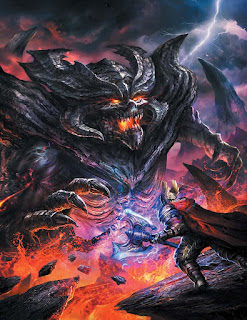
The setting is really interesting and deep. It goes, roughly, like this. A long time ago man invented super magic and decided to go to God and discover who was right in all the petty squabbles. SO they invented even bigger magic and invade heaven. They fought their way past loads of angels and stuff. Eventually they made it to the throne of the most high and discovered it empty. So the people decided that if god wasn't around they would make their own gods, and commenced to cannibalize heaven to build Made Gods to represent the ideals of the people. Eventually this led to war and destruction and as they had cannibalized heaven the engines of creation were damaged and now the world is split into shard realms floating in the undifferentiated night. Meanwhile the angels sit in Hell, where they regrouped, and plan their revenge on mankind and the world. The game then give a really solid example shard realm with all sorts of different countries and factions. Each one tailor made for different kinds of adventure. My favorite is the bright republic, which has super high tech, but their celestial engines are old and must fail soon, unless some heroes were to fix them. Their tech does not work in the rest of the world. The further they get from the celestial engines of the bright republic the more likely they are to fail. There is also Ancalia, facing undead and other threats, which just recently got a really well put together expansion book, which I would also recommend. Needless to say the setting is top notch, but with the rules you could play in a whole bunch of settings. I have put together a couple already, one is set at the dawn of mankind's first civilizations, kind of a stone/bronze age mythic romp in a lost world type setting. The other setting is closer to Planescape, but using the setting conceits of Godbound's core setting, rather than the setting conceits of D&D. I will probably post those to the blog on some later date. I have even heard of people using these rules for playing in Creation from Exalted.

So that is it for today. Thanks for reading.

Next time...

Teenage.

Mutant.

Ninja.

Turtles.

Wednesday, December 21, 2016

Ninth Game of Christmas

Previously: Alternity, Star Wars, Mage, Transhuman Space, Adventure!, Feng Shui, Fate Core, 13th Age

Today...

When the other games I have done were difficult, it usually meant that I either had some mixed feelings on a key component or I liked the game too much. This game is going to be difficult for a very different reason. I could be wrong. The game we are going to look at today require a crazy amount of system mastery and is geared toward long term play. Both of those things could lead me to make a factual error on the nature of this game. So bear in mind I have not played this game as much as is recommended in order to fully understand it. So I could be wrong. Bear that in mind while we dig into...

Burning Wheel
This game is intense. it is filled with niche rules and subsystems that all interact with each other in important ways. It can be very daunting to get into. Heck I have played it a fair bit(for me) and I am still daunted by the mechanical depth on display. And it is depth. A lot of games with this level of crunch are often strange hodgepodges that were constructed, seemingly, at random. Not so Burning Wheel. Everything in this game feels deliberate and focused. Its just that sometimes I am not sure what it is focused on. Many people have an issue with the tone the designer takes in the game, and I get that complaint. Sometimes the game can feel a little bit like it is talking down at you. That said the game is very good and when it is played well it practically sings.

Peritextual Elements
The book I will be using is the Gold edition. Which covers a lot of the additional material that had been added on to the basic game in the previous edition. The art is sparse. It is black and white line art with a sort of sketchy feel. There are no sidebars of any note. Each chapter has a little illustration up in the corner of the page so that there is a visually distinct way to quickly jump to the chapter you need. The book is hard bound and a beautiful book at that. It has a sort of fleur de lis pattern in red on a golden background. the title and wheel design sort of blend into that background. Not sure if I like the color choices, bu the book is very distinct. Also each page within has a medieval style set of knot works drawn as a border for the margins. Again not sure how I feel about it, but it is interesting and evocative. Overall it is a good looking book, though some of the choices might not be to your tastes.

Mechanics
The core mechanic is a d6 based dice pool system where you are looking at each die to see if the die surpasses a target number and then you count successes. You have attributes and skills these are added together to give the dice pool(I think). You can also get a die or two from someone with the same skill helping you and you can get extra dice from related skills, call FoRKs(fields of related knowledge). You also get artha, which are a bunch of different kinds of points that can be spent to alter the dice rolls in a number of ways. I would go further into that but it gets pretty complex pretty quick. And you only really need to know the basics of how dice rolls work for now. Your character also has beliefs and instincts, which are how you gain artha(which is very important, as this game can be very lethal). Beliefs are goals you have set for your character that you wish to accomplish. You gain artha when you accomplish the goals. You have three of them. Instincts are macros for you character. They are things that your character always does or always does in certain types of circumstances. I think you can gain artha from these too, but I might be mis-remembering, or I may have played it wrong. If you want your character to always have a knife on him, or always fill his pockets with food when available, instincts make that happen without you having to tell the GM that every time.

Character creation is fairly complex and in depth. You make your character through a life path system. The GM will tell you how many path choices you get and what paths will be available or forbidden. There are many different paths available and each one will influence how the world looks around you. When you have made all your choices, you find out how old you are and how many points for physical and mental traits that gives you. The samples in the book are Human paths, Elven paths, Dwarfish paths, and Orcish paths.

There are a load of subsystems for a bunch of different conflicts and such. Fighting breaks down into range and cover and fight. Fight is in close melee type stuff and it is really lethal. Range and cover is ranged and it can be even more lethal. Duel of the wits is how it handles social conflict. For many of these there are lists of tactics you can use in a moment by moment basis and you must choose your actions three at a time and you cannot change them mid stride, and you do not get to see your opponents moves until later. Combat and debate end up feeling really tense and require you to out guess your opponent and play the game as well as playing the game, if you know what I am saying. As I said these systems can get very fiddly and complex.

Advancement is probably my favorite part of the game and something I plan on stealing for things in the future. Basically to advance a skill or an attribute you need to take a number of tests as a set number of required successes. So to advance a skill from four to five would require you take four routine tests(1-2 successes) and two difficult tests(3-4 successes). I want to use something like this for a game based on Dragonball Z. As you get more advanced in a skill you need more difficult or higher tests and it can get very hard to find situations which challenge you enough to advance.  I know I have not covered everything in detail, but I hope I have shown a hint of why this system is so unique and interesting.

Setting
This game does not have a direct setting as such. However it does have an implied setting that is really quite spiffy. It is a very Tolkien inspired setting while also being very much in the vein of a Medieval Romance and a little bit of Wizard of Earth Sea, Conan, and Lankhmar. This game reminds me a great deal of the fun I used to have as a kid playing MERP(Middle Earth Roleplay), and the big lists of things that would build the setting through character creation, at least in my mind. This game does that in spades. Each choice you make in character creation builds the world up a little bit, and when you get to beliefs you start building what is most important and thus what will show up in the game. You also have a skill(sort of) called circles, which you roll to create NPCs who know your character. How well you do describes how they relate to you and builds interesting interactions with the world. The longer you play the game the more you flesh out the parts of the world you care most about and it can get quite nuanced and interesting. That said it does not have full setting on its own, it just grants you the tools to make the setting you want and make it matter as much as you want it to matter. I like that.

Tomorrow...

Godbound

Tuesday, December 20, 2016

Eighth Game of Christmas

Previously: Alternity, Star Wars, Mage, Transhuman Space, Adventure!, Feng Shui, Fate Core

And Now...

Before I start, a bit of a confession. I do not care much for the tropes of the games that led to the creation of this game. It just fails to appeal, mostly. That said I have played a lot of the previous games, as I am sure you have too. Hard to avoid it really. That said I rather enjoy this incarnation of the tropes and the mechanics just sing. So without further ado...

13th Age

So yeah, I do not normally care much for the tropes of D&D and I don't much like it in general. I like a lot of the stuff that came out of it, but by and large D&D just kind of fell flat for me for years. I think this has to do with my love of playing fighting men and D&D's steadfast refusal to make that a choice worth making. So for years and years I avoided D&D mostly. I would play here and there, because it could not be avoided and I didn't hate the game completely. Then came 4th Edition. I was one of those people who did not hate 4th edition, in fact I was one of those people who loved it. finally the game was trying to balance all the classes and levels, so that tenth level meant tenth level no matter what class you had. That said I got what people did not like about the game, the class powers did tend to have a sameness to them and skill challenges were very poorly described. Anyway I moved on to other games and never gave it much thought again. Then along came 13th Age and here was a game that had something like balance, while also making each class feel completely different in play and having different values for leveling up. My favorite character was my sorcerer who practiced martial arts and would use his spells in melee. I based him off of Goku from Dragon Ball Z. It was a hoot. But lets get to the review, yeah?

Peritextual Elements
This book is just beautiful. High gloss medium weight pages of full color art and side bars. It reuses the art, but it is done in a genius way. The images of the Icons are used in the icon descriptions and as the intro art for the chapters. The pictures are beautiful, even the sketchy images used in some of the chapters. In the bestiary section the monsters do not have full illustrations but have specific diagrams that represent that creature in a unique way and could easily be made into tokens for the table to show distances and numbers. Not sure if that fully works, but it is an interesting idea and a good way to stretch an art budget. It is well indexed and referenced, I have had little trouble finding what I need in play.

Mechanics
Have you played D&D 3.x or 4? OK then you get the basics of how the game rules work. You roll a d20 and compare to a target number either set by the GM or the defense of the monsters you are fighting. There are loads of sections explaining how to set up appropriate difficulties that would best apply to the level of the characters. In fact the book is chock full of advice from top to bottom. The game is really set up for ease of play on all levels, but especially for GMs, and I love that. If there is one thing I hate, it is a game that fails to help the GM do their job. So some of the best new additions to the mechanics? There are no skills. Instead there are backgrounds which are rated like skills and apply whenever it would be appropriate. These backgrounds are created by the players during character creation, though there are loads of examples throughout the various classes and such. These can add a bunch to the world and how your character fits in it. Another new addition is the One Unique Thing, which is something every player character has and is truly unique to them. That means that if a player take something as their one unique thing then that is true. If they are the last elf to be born, then that means no more elves can be born after them. That is a lot of control and there is a lot of advice given on how to build and use these in play. I love the One Unique Thing. It is such a simple thing, yet it makes the game world special and interesting.

Finally there are Icons. Icons are the movers and shakers in the world. They are the most important beings that the players can(and do) interact with. Basically when you make a character you set up you relationship with one or more Icons as either Beneficial, Detrimental, and conflicted. At the beginning of most sessions(and sometimes at other times) you roll a number of six sided dice equal to your relationship with the icon(relationships max at three). if you roll a five or a six you check the chart for your relationship type and see what happens. Basically this acts as an adventure generator and a way to gain neat benefits for interacting with the Icon or the groups they represent. Gonna be honest here, I don't mush like the Icons system. I don't hate it or anything, but I have yet to see it used super well in games I have played. that may just be how things go in my games though, so I will continue to try and use the system.

Finally there is the escalation die, which is my favorite rule. At the end of the first round of combat a d6 is set down on the table showing one pip. In the next turn it is turned to two, and so on up to six in the seventh round. What this does is adds that number you your players' attack rolls. There are also a bunch of abilities that players can get that allow them to manipulate and use the escalation die for a bunch of stuff. This speeds up combat while still allowing for challenge. Also some of the big scary monsters, like dragons, get funky abilities that manipulate or use the escalation die for various effects, It is such a simple addition to the rules and yet it adds a whole new layer of tactical thought to the game.

Setting
The setting is every generic fantasy trope ever. Except remove all the boring bits and make everything an adventure. Remove everything that is not. It is set in the Dragon Empire in the 13th Age(I know, right?! what a shocker). The world has all sorts of interesting things going on in it. Like the Behemoths that are these massive creatures(much bigger than a tarrasque) that migrate constnatly across the land. They are so big that some people live on them and are nomads with a constant home. Then there is the overworld, which is made of the clouds and you can get to it by climbing the clouds. and then there are also floating islands, an underdark type place, a bunch of enchanted forests, my favorite being the elf queens court. It s so cool because it has all three elf types in it. The wood elves live among the trees, the high elves live in the tops of trees and in towers and such, and the drow live in tunnels and caves among the roots of the trees. See it all sounds boring and silly when I describe it, but it really does work well in the book and in play. Like I said everything is player facing and designed for GM convenience. Everything is sitting on a knifes edge and there are loads of adventure hooks. I enjoy the setting most though, because it will be different every time you play it. Characters' One Unique Thing and backgrounds will let the GM know all sorts of interesting things about the setting and what the players want to do with it. The setting really is a love letter to GMs who have run games in the standard dungeon fantasy for years.


Next time...

Burning Wheel